Yesterday’s Budget ended up as somewhat of damp squib, if you are to take as read the front pages of yesterday’s papers. The Prime Minister’s rhetoric on hope and bringing about radical transformation has seemingly run ahead of what the Government is able to offer, given the lack of economic bandwidth available. We await the PM’s ten-year plan which, alongside next year’s Spending Review (date to be confirmed), should map out in more detail the direction which the Government is looking to take.
Focusing on the here and now, we already knew that tough spending decisions were baked in towards the end of this Parliament, and the pain ahead – when looking at departmental budgets in the next few years – makes for sobering reading. The respected Institute for Fiscal Studies (IFS) says there is a £28 billion shortfall in the public finances, just to maintain existing services.
The state of justice:
From a purely justice perspective, the situation is particularly precarious. Investment in the justice system will remain stagnant when digging into the figures between now and the end of the decade. From this financial year until 2028-29, day-to-day spending at the Ministry of Justice will increase from £12.7bn to £13bn which, in essence, is a real terms cut. Capital spending (think the government’s prison building programme) will stay at £2.3bn between now and 2028-29, before falling to £1.9bn by 2029-30.
In a further blow to hopes for additional cash, the shortfall in the Defence Investment Plan will partially be made up via £3bn worth of cuts to the capital budgets of government departments.
Within the current Spending Review period, the Office for Budget Responsibility referenced the justice system as ‘where cost pressures could be significantly higher’, specifically noting the potential for an increase in probation costs given the impact of the early release scheme. As was always likely, many of the measures contained within the Sentencing Act – though welcome, particularly in the shift towards more of a focus on community alternatives to custody – are shifting pressures from prisons to probation, and ongoing struggles to reach recruitment targets will only exacerbate the strain within the Probation Service. This is despite the previously announced £700m a year funding commitment by 2028/29 for probation.
There was one additional probation-related measure in the Budget – the national rollout of Justice Transcribe, with the aim of freeing up probation officers to spend more time supporting rehabilitation and reducing reoffending. Bringing the system into the 21st century via technology will be an important component in both modernising probation and in finding efficiencies, but the systemic problems are wider and will require much more to move the dial.
Ahead of the Budget, new Justice Committee chair, Catherine Atkinson MP – in a letter to the Lord Chancellor – wrote that ‘many of the challenges facing the Ministry of Justice are rooted in long-term resource and capital pressures.’ Atkinson highlighted services struggling to cope with rising demand (something we have consistently referenced through Clinks’ State of the Sector research), and called for answers on key committee recommendations. These include ensuring that all prisons ‘retain the funding necessary to deliver core education budgets’, ‘improving participation and quality in prison education’, and ‘removing the six-year funding requirement to enable all prisoners access to higher education.’ Clearly, given the almost non-existent references to the justice system yesterday, these demands have not been met.
Our analysis on prisons is light given there was no focus on the prison estate – bar the numbers on capital spending – within the budget documents. We won’t repeat the well-versed arguments about the state of our prison system in this piece but, as with probation and has been covered extensively across the media, it is another part of the system that is teetering on the brink. One point that is important to note is that the headroom in the estate that the government hoped to achieve via the early release scheme is fast being erased – given that more people were recalled to prison than released, across the first half of 2026.
Positive steps taken to tackle rough sleeping:
On a more positive note, increased funding for tackling rough sleeping, and the direction given by the Prime Minister, is hugely welcome. The Chancellor announced an additional £432m which, on top of previous commitments, brings the total number up to nearly £900m. Many of our members have been particularly vocal on the issue of rough sleeping/homelessness, particularly the fact that it cannot be eradicated without tackling homelessness amongst people leaving prison. The detail will therefore be critical regarding how this funding is allocated and whether, as is often the case, those leaving prison are de-prioritised when it comes to securing accommodation.
Tackling misogyny:
The Government announced £15m over three years for a Misogyny Prevention Fund, designed to address attitudes and behaviours before they can escalate into violence and abuse. This funding will sit under a new National Taskforce for Tackling Misogyny, led by Bridget Phillipson (Minister for Women and Equalities). Interestingly, there was no accompanying funding for the voluntary sector delivering in the domestic abuse space, and as with the rough sleeping funding, the prioritisation/allocation of resources will be key.
Interesting innovations – preventative spending:
One announcement that really caught our eye was for a new, ringfenced category of departmental expenditure on prevention, that has been designed to set aside specific funding for early intervention and prevention. This is hugely welcome – investing in prevention must form a critical component in any efforts to reform our wider justice system. The risk remains though that, without additional funding, the new category will simply divvy up dwindling sums of money into a greater number of pots.
Looking ahead:
There are inevitably going to be painful decisions that the Government must take, and imminently. The upcoming Spending Review is likely to be stringent when it comes to justice, which will make the current situation all the more difficult given the historic and ongoing underfunding of the system and its subsequent challenges. The IFS has set out the extent of this funding challenge, noting in 2025 that ‘had the Ministry of Justice’s day-to-day budget increased at the same rate as the average department since 2007-08, it would have been some 41% (£4.5 billion) higher in 2024-25.’
There is perhaps some hope in the form of the PM’s ‘devolution by default’ mantra, which may necessitate a shift from the voluntary sector in terms of its engagement with government stakeholders, from a national to regional level. Tapping into local funding pots may very well be the most effective route for ensuring the financial sustainability of the sector and for a future justice system to move towards a more stable footing.
What's new

Publications
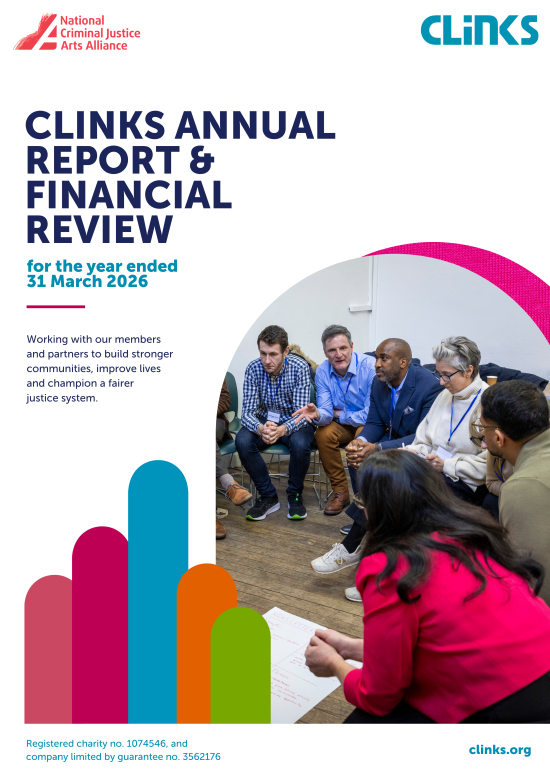
Clinks Annual Report & Financial Review for the year ended 31 March 2026
Clinks’ Annual Report 2025-26 h
Latest on X
 Clinks @clinks_tweets · 2 years
The role is for a leader from an organisation focused on racially minoritised people, with expertise in service delivery, policy, advocacy, or related areas in criminal justice. Racial disparities are present at every CJS stage. This role ensures these voices are central in shaping policy to help address and eradicate them. Apply by Mon 18 Nov, 10am. More info: https://www.clinks.org/voluntary-community-sector/vacancies/15566 #CriminalJustice #RR3 #RacialEquity