Introduction
For children and families, imprisonment reaches far beyond the prison gate. It can bring stigma, isolation and uncertainty, while the people trying to hold families together are too often overlooked or left to find support for themselves. As highlighted in Clinks' voluntary sector-led manifesto, a fairer response means recognising every child affected by imprisonment, creating non-judgemental routes into support, improving family engagement across the criminal justice system, and sustainably funding the voluntary organisations that families trust.
These recommendations are brought to life in this guest blog by Leah Stanley, Founder of Through the Sentence. Drawing on her work with children and families navigating the criminal justice system, Leah explores what imprisonment can mean for a child, why the way support is offered matters, and how the Clinks manifesto could help replace stigma and suspicion with respect, practical help and lasting change.
For many children, the impact of imprisonment starts long before any support is offered. It starts with the stories they feel they have to tell.
What do you tell a child to say about where their family member has gone?
It's one of the first things you notice when you work with children affected by the imprisonment of a parent, sibling or other close family member. Most children turn up already having a story ready. A parent or relative "away for work." Nobody taught them to do this. They worked it out on their own, from watching how the adults around them react when the truth slips out.
The numbers
Those experiences are far from rare.
219,000. That's the Ministry of Justice's newest estimate for how many children in England and Wales had a parent in prison between October 2023 and October 2024, using a more direct way of counting children rather than the previous method's estimated average per person in prison. That's a 14% rise on the earlier estimate of 192,912 for 2021 to 2022, though the MoJ is clear that part of the rise comes from the new counting method itself and not only from a larger prison population, so the two figures aren't directly comparable. Around 2% of school aged children in England and Wales are thought to have a parent in prison.
Crest Advisory's separate estimate, counting new cases each year rather than one snapshot, comes to 312,000.
Nobody is currently required to check on these children. No court tells a school, and no single agency owns the job of finding out if they're okay. Families who want help usually have to find it for themselves.
Self-Identification
The Clinks manifesto calls it non-judgemental self-identification, meaning a way into support that doesn't automatically set off a safeguarding investigation without further risk analysis. Parents often stay quiet about their situation precisely because naming the situation can get read as a risk flag rather than a request for help.
There's more that needs to sit behind that one ask, too. A national awareness campaign and training that's mandatory, not optional, for teachers, youth workers, GPs, whoever a child's most likely to tell first (assuming they tell anyone at all) and a promise that support follows how a family wants to be helped, rather than the other way round.
Okay, so a child needs support. Then what?
Children affected by a family member's imprisonment are around twice as likely as their peers to have conduct or mental health problems, and face higher risks to their education and their life chances further down the line. Most of that isn't down to the imprisonment itself, not directly. It's the isolation and the stigma a child picks up through no fault of their own. The sense that this has only ever happened to them, out of everyone they know.
How support is offered matters as much as whether it's there.
A child who's spent months hiding this doesn't want a new label confirming they're different from everyone else. Being welcomed into a club rather than invited to a support group is a small difference on paper, but it can decide whether a child comes back. Mostly they just want somewhere to be a child alongside other children who happen to get it.
It doesn't stop at the school gate, either
Families carry stigma into prisons too, and kids notice more of it than the adults around them sometimes assume. Bag searches, staff treating every visitor like a potential risk instead of someone trying to hold a family together, an atmosphere built around suspicion rather than anything resembling welcome. The Clinks Families Network's Memorandum of Understanding is a commitment to challenge that, and the manifesto backs it up with something more concrete, real family engagement training for prison staff, and visiting rooms designed with a child in mind.
Families should be part of the care
When someone goes into prison, the people who know them best are often shut out.
Families have usually been there long before custody, the partner who knows the signs when someone's mental health is slipping and the sibling who can tell something is wrong from one phone call.
In a survey of 159 visitors at HMP Brixton, half said they did not feel involved enough in their relative's healthcare, while one in six families interviewed by PACT raised safeguarding concerns that needed escalating. Behind those figures are people waiting days for a call back and being treated with suspicion when they're trying to help.
Keeping families involved matters for more than healthcare alone. Strong family relationships can improve wellbeing during custody, strengthen ties that support successful resettlement, and help people rebuild their lives after release. Recent Ministry of Justice analysis found that people in prison who received family visits were less likely to reoffend after release (25% compared with 28% for those who did not receive visits).
Clinks’ manifesto recognises that families have an important role to play. Proposals such as opt-in health consent at induction, family liaison roles within prison healthcare, and greater family involvement in resettlement planning would create safe and appropriate ways for families to contribute, always with the consent of the person in prison. Rather than shutting families out, these measures would help build the partnerships that are often essential to long-term wellbeing, successful rehabilitation and positive outcomes for children and families alike.
None of it works without money
Recognising a child means nothing if there's nowhere to send them afterwards.
Mentoring, a peer group, a trusted adult who isn't their teacher or a social worker, this already exists in the voluntary sector, but it's just running grant cycle to grant cycle, which is not really a way to run anything long term. The manifesto calls for multi-year statutory funding and independent hubs away from the prison gate. For smaller organisations, still building up their income year by year, that's not a nice to have - It's the difference between a mentor being able to see a child for as long as they need it and having to stop because the grant ran out first.
What I value most about the Clinks manifesto is where it comes from. It's built what organisations within the voluntary Sector have been saying for years, including the children and families organisations. The Ministry of Justice does not need to tackle this challenge on its own. Meaningful change will require a coordinated response from across government, including the Department for Education and public health partners. If those organisations come together around the manifesto's recommendations, they could make a lasting difference to the lives of children and families affected by imprisonment. For a child, one adult who treats their family with respect, one visit that feels safe, or one trusted source of support can make all the difference in how they carry this experience.
Whether any of this gets built is of course a separate question. Clinks have set out what ‘joined up’ looks like. Naming a problem and funding the fix are two different things, and the gap between them is where most of these children have been sitting for a very long time.
Further information:
This blog was written by Leah Stanley, Founder of Through the Sentence
Through the Sentence supports children with a family member navigating the criminal justice system, throughout the whole journey.
Learn more about Through the Sentence, here.
What's new

Publications
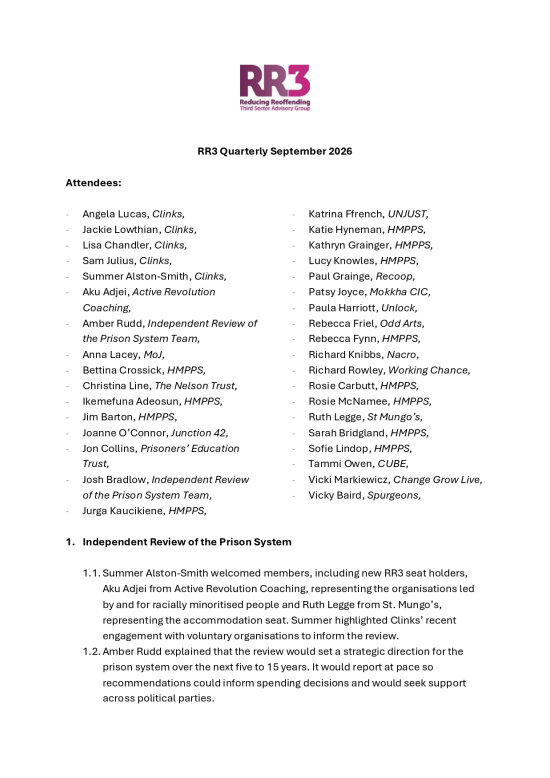
RR3 Quarterly September 2026 Minutes
This document provides a summar
Latest on X
 Clinks @clinks_tweets · 2 years
The role is for a leader from an organisation focused on racially minoritised people, with expertise in service delivery, policy, advocacy, or related areas in criminal justice. Racial disparities are present at every CJS stage. This role ensures these voices are central in shaping policy to help address and eradicate them. Apply by Mon 18 Nov, 10am. More info: https://www.clinks.org/voluntary-community-sector/vacancies/15566 #CriminalJustice #RR3 #RacialEquity